



AI Recruitment Agency
How AI-Powered Recruitment Agencies Reduce Bias and Accelerate Talent Acquisition
If you speak with any CEO or CHRO today, one theme comes up again and again: hiring has become harder than it should be.
Not because there is no talent in the market.
Not because companies lack ambition.
But because the process itself hasn’t always kept up with the speed and complexity of modern business.
Roles are more specialized. Skill requirements change faster. Diversity expectations are higher. And competition for top candidates is intense, especially in technology and professional services.
That is why AI-powered recruitment agencies are becoming trusted partners for enterprise organizations. Not because artificial intelligence is fashionable, but because it solves real-world hiring problems practically.
This shift isn’t about replacing recruiters. It’s about equipping them with better tools so they can make smarter, fairer, and faster decisions.
The Hidden Problems in Traditional Hiring
Traditional hiring looks easy from the outside. When you post a job, receive resumes, take interviews, and select someone. But when you actually go through the process, it is not that simple. Reading resumes one by one takes a lot of time, and every recruiter has a different way of judging profiles. What feels like a strong candidate to one person may not seem the same to someone else. Sometimes, small personal preferences also affect decisions without us even noticing.
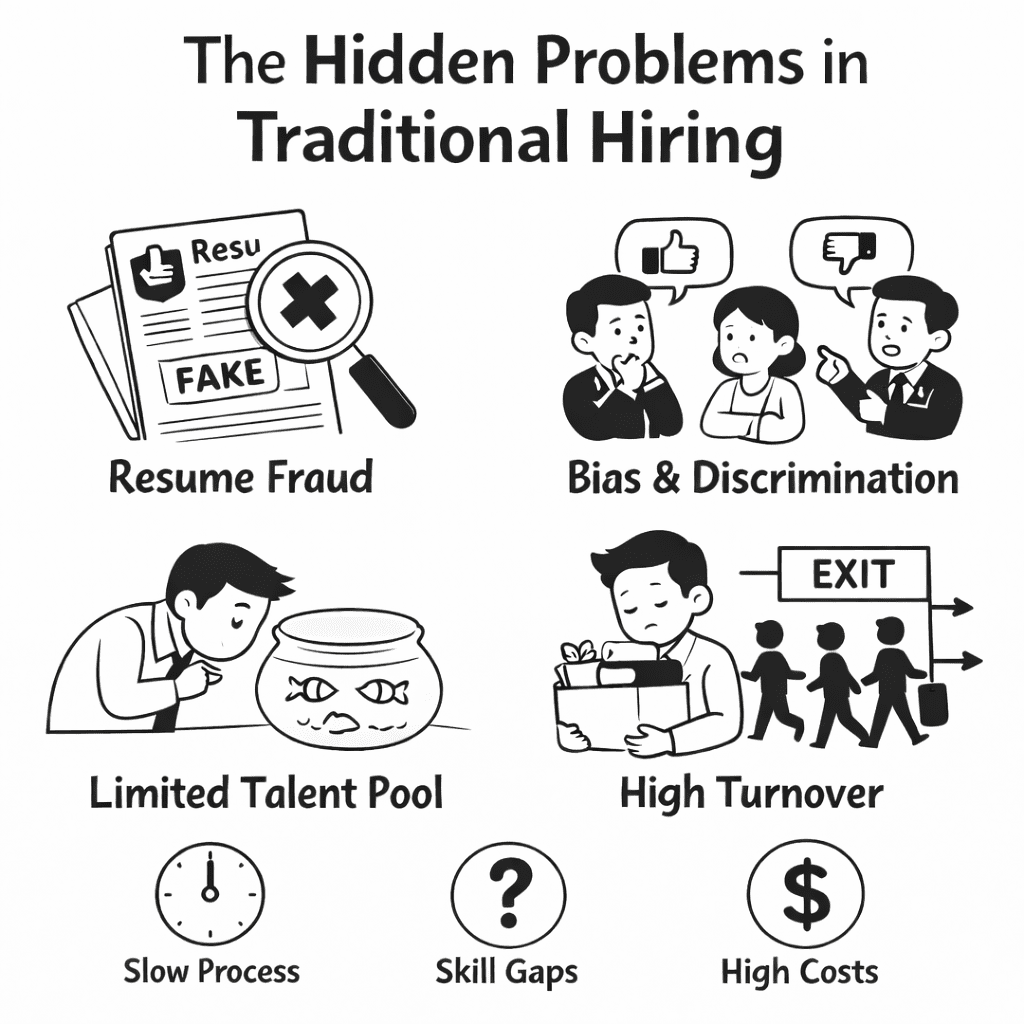
Another big challenge is time. Good candidates don’t stay available for long. They are talking to multiple companies at once, and if your process moves slowly, they may accept another offer before you are ready to decide.
For businesses, this can create serious issues. Work gets delayed, teams feel overloaded, and growth opportunities may be missed. When hiring becomes urgent, it often leads to the wrong match, which later increases turnover. Having a clear and well-organized hiring process, supported by the right tools, can save time and help companies make better, long-term decisions.
Reducing Bias in a Practical, Measurable Way
Bias in hiring doesn’t always look dramatic. It can be subtle.
A recruiter may unconsciously favor a familiar university. A hiring manager might lean toward candidates with similar career paths. Certain profiles may be overlooked simply because their experience doesn’t follow a traditional format.
AI recruitment solutions help introduce consistency at the earliest stages of evaluation.
Focusing on Skills First
Modern systems can remove identifying information during screening and rank candidates based on:
- Core competencies
- Relevant experience
- Certifications
- Demonstrated results
For diversity recruitment firms, this creates a more level playing field. Instead of filtering based on background or familiarity, the focus shifts to capability.
Standardized Evaluation
AI tools also help create structured scoring models tied directly to role requirements. Everyone is measured against the same criteria.
That structure matters at the enterprise level. It reduces variability between hiring managers and strengthens compliance documentation.
At Employvision, AI supports this structured approach—but final hiring decisions remain firmly human. Data informs judgment; it doesn’t replace it.
Matching Beyond Keywords
One of the biggest frustrations in hiring is keyword matching.
A candidate might be incredibly capable, but if their resume does not use the exact wording from a job description, they get overlooked.
AI recruitment solutions have evolved beyond simple keyword scanning. Modern systems analyze patterns:-
- Career growth over time
- Skill relationships
- Project complexity
- Industry exposure
This is especially valuable in professional services staffing, where leadership ability and industry depth matter just as much as technical qualifications.
A resume only tells part of the story. Smart systems help recruiters see more of it.
Direct Hiring Is a Long-Term Bet
When companies partner with a direct hire staffing agency, they’re not just filling a role. They’re making a commitment.
A permanent hire affects team culture, stability, and long-term planning. The cost of getting it wrong is bigger than most people realize.
AI can’t predict the future perfectly. But it can highlight patterns tied to retention, performance consistency, and career stability.
That gives recruiters better starting points for deeper conversations.
At Employvision, the goal isn’t to let algorithms decide. It’s to walk into every client discussion with stronger insights and clearer direction.
That combination—data plus human instinct—is powerful.
Diversity is not just a Metric
There has been a lot of talk about diversity over the past few years. Some of it is genuine. Some of it is surface-level.
But organizations that truly invest in inclusive hiring understand something important: diversity drives better decisions.
AI helps diversity recruitment firms widen the net. It searches beyond traditional networks. It surfaces talent from adjacent industries. It highlights candidates who may not follow the expected path—but bring strong capability.
Equally important, AI can track diversity metrics across each hiring stage. Leaders can see where candidates are advancing and where they are dropping off.
You can not improve what you do not measure.
Traditional vs AI-Supported Recruitment
|
Area |
Traditional Approach | AI-Supported Approach |
|
Resume Review |
Manual and time-heavy |
Automated shortlisting |
|
Evaluation |
Varies by recruiter |
Structured scoring |
|
Hiring Speed |
Slower |
Faster |
|
Diversity Tracking |
Limited visibility |
Real-time monitoring |
|
Talent Reach |
Narrow networks |
Broader sourcing |
| Scalability | Resource dependent |
Enterprise-ready |
The difference isn’t about replacing people. It’s about reducing friction.
The Human Element Is Still Everything
Here’s something important.
AI does not understand ambition.
It does not make sense to hesitate in an interview.
It does not build trust with a candidate considering a career move.
Recruiters do that.
The best recruiting firms use AI to handle repetitive work screening, sorting, and scheduling so they can focus on what humans do best: listening, advising, and building relationships.
Employvision follows that philosophy closely. Technology supports the process, but real conversations drive decisions.
And honestly, that balance is what makes the model work.
Enterprise Leaders Want More Than Resumes
Today’s enterprise decision-makers expect recruitment partners to think strategically.
They want:-
- Faster hiring cycles
- Lower turnover
- Better diversity outcomes
- Access to niche expertise
- Clear workforce insights
AI-powered talent acquisition solutions help deliver those outcomes more consistently.
But technology alone is not the solution. Without human judgment, context, and accountability, even the smartest systems fall short.
It is the partnership between structured data and experienced recruiters that creates real momentum.
Responsible Use of AI
There’s also an important conversation around responsibility.
AI must be monitored. Audited. Reviewed. If left unchecked, systems can replicate bias instead of reducing it. That is why reputable agencies build compliance checks and transparency into their processes.
Used carefully, AI reduces risk. Used carelessly, it creates it. That distinction matters.
Better Hiring Through Structure and Experience
AI-powered recruitment is not about replacing the human side of hiring. It’s about giving recruiters better tools. Clearer visibility. Stronger structure.
It helps reduce bias. It accelerates screening. It expands access to talent. And it allows hiring teams to spend more time on real conversations instead of administrative tasks.
Firms like Employvision are proving that when AI recruitment solutions are paired with real expertise, enterprise hiring becomes not only faster—but fairer and more thoughtful.
At the end of the day, companies don’t grow because of software. They grow because of people. Connect with Employvision to explore AI-powered recruitment solutions tailored for enterprise growth as the right talent strategy drives business performance.
Email: info@employvision.com
Contact us: https://employvision.com/contact-us/
Frequently Asked Questions
1) Is AI the replacement for recruiters in hiring?
Ans: No. AI acts as support by screening resumes and analysing data, but recruiters conduct interviews, assess cultural fit, and guide final decisions.
2) How does AI reduce bias?
Ans: By standardizing evaluation criteria and anonymizing early screening, and focusing on measurable skills instead of subjective impressions.
3) Is AI especially useful for technology hiring?
Ans: Yes. For technology staffing companies and IT staffing and consulting companies, AI helps quickly identify specialized technical skills and align them with project needs.
4) Why is AI-supported direct hiring important?
Ans: Because it improves alignment, reduces time to hire, and increases the probability of long-term success—though no system is perfect, it helps reduce risk.